Kamis, 06 Juni 2013

Credit Card


A. Definition of Credit Card
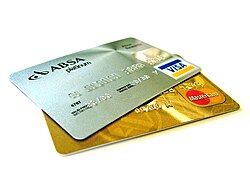
A credit card is a payment card issued to users as a system of payment. It allows the cardholder to pay for goods and services based on the holder's promise to pay for them.The issuer of the card creates a revolving account and grants a line of credit to theconsumer (or the user) from which the user can borrow money for payment to a merchant or as a cash advance to the user.

A credit card is different from a charge card: a charge card requires the balance to be paid in full each month. In contrast, credit cards allow the consumers a continuing balance of debt, subject to interest being charged. A credit card also differs from a cash card, which can be used like currency by the owner of the card. A credit card differs from a charge card also in that a credit card typically involves a third-party entity that pays the seller and is reimbursed by the buyer, whereas a charge card simply defers payment by the buyer until a later date.

The size of most credit cards is 3 ⅜ × 2 ⅛ in (85.60 × 53.98 mm),conforming to the ISO/IEC 7810 ID-1 standard. Credit cards have an embossed bank card number complying with the ISO/IEC 7812 numbering standard.


B. History Of Credit Card


The concept of using a card for purchases was described in 1887 by Edward Bellamy in his utopian novel Looking Backward. Bellamy used the term credit card eleven times in this novel, although this referred to a card for spending a citizen's dividend rather than borrowing.

The modern credit card was the successor of a variety of merchant credit schemes. It was first used in the 1940s, in the United States, specifically to sell fuel to a growing number of automobile owners. In 1938 several companies started to accept each other's cards. Western Union had begun issuing charge cards to its frequent customers in 1921. Some charge cards were printed on paper card stock, but were easily counterfeited.

The Charga-Plate, developed in 1928, was an early predecessor to the credit card and used in the U.S. from the 1930s to the late 1950s. It was a 2½ in × 1¼ in rectangle of sheet metal related to Addressograph and military dog tag systems. It was embossed with the customer's name, city and state. It held a small paper card for a signature. In recording a purchase, the plate was laid into a recess in the imprinter, with a paper "charge slip" positioned on top of it. The record of the transaction included an impression of the embossed information, made by the imprinter pressing aninked ribbon against the charge slip. Charga-Plate was a trademark of Farrington Manufacturing Co. Charga-Plates were issued by large-scale merchants to their regular customers, much like department store credit cards of today. In some cases, the plates were kept in the issuing store rather than held by customers. When an authorized user made a purchase, a clerk retrieved the plate from the store's files and then processed the purchase. Charga-Plates speeded back-office bookkeeping that was done manually in paper ledgers in each store, before computers.

In 1934, American Airlines and the Air Transport Association simplified the process even more with the advent of the Air Travel Card.They created a numbering scheme that identified the issuer of card as well as the customer account. This is the reason the modern UATP cards still start with the number 1. With an Air Travel Card, passengers could "buy now, and pay later" for a ticket against their credit and receive a fifteen percent discount at any of the accepting airlines. By the 1940s, all of the major domestic airlines offered Air Travel Cards that could be used on 17 different airlines. By 1941 about half of the airlines' revenues came through the Air Travel Card agreement. The airlines had also started offering installment plans to lure new travelers into the air. In October 1948, the Air Travel Card became the first inter-nationally valid charge card within all members of the International Air Transport Association.

The concept of customers paying different merchants using the same card was expanded in 1950 by Ralph Schneider and Frank McNamara, founders of Diners Club, to consolidate multiple cards. The Diners Club, which was created partially through a merger with Dine and Sign, produced the first "general purpose" charge card, and required the entire bill to be paid with each statement. That was followed by Carte Blanche and in 1958 by American Express which created a worldwide credit card network (although these were initially charge cards that acquired credit card features after BankAmericard demonstrated the feasibility of the concept).

However, until 1958, no one had been able to create a working revolving credit financial instrument issued by a third-party bank that was generally accepted by a large number of merchants (as opposed to merchant-issued revolving cards accepted by only a few merchants). A dozen experiments by small American banks had been attempted (and had failed). In September 1958, Bank of America launched theBankAmericard in Fresno, California. BankAmericard became the first successful recognizably modern credit card (although it underwent a troubled gestation during which its creator resigned), and with its overseas affiliates, eventually evolved into the Visasystem. In 1966, the ancestor of MasterCard was born when a group of banks established Master Charge to compete with BankAmericard; it received a significant boost when Citibank merged its proprietary Everything Card (launched in 1967) into Master Charge in 1969.

Early credit cards in the U.S., of which BankAmericard was the most prominent example, were mass produced and mass mailed unsolicited to bank customers who were thought to be good credit risks. But, "They have been mailed off to unemployables, drunks, narcotics addicts and to compulsive debtors, a process President Johnson's Special Assistant Betty Furness found very like 'giving sugar to diabetics'." These mass mailings were known as "drops" in banking terminology, and were outlawed in 1970 due to the financial chaos they caused, but not before 100 million credit cards had been dropped into the U.S. population. After 1970, only credit card applications could be sent unsolicited in mass mailings.

The fractured nature of the U.S. banking system under the Glass–Steagall Act meant that credit cards became an effective way for those who were traveling around the country to move their credit to places where they could not directly use their banking facilities. In 1966 Barclaycard in the UK launched the first credit card outside of the U.S.

There are now countless variations on the basic concept of revolving credit for individuals (as issued by banks and honored by a network of financial institutions), including organization-branded credit cards, corporate-user credit cards, store cards and so on.

Although credit cards reached very high adoption levels in the US, Canada and the UK in the mid twentieth century, many cultures were more cash-oriented, or developed alternative forms of cash-less payments, such as Carte bleue or the Eurocard (Germany, France, Switzerland, and others). In these places, adoption of credit cards was initially much slower. It took until the 1990s to reach anything like the percentage market-penetration levels achieved in the US, Canada, or UK. In some countries, acceptance still remains poor as the use of a credit card system depends on the banking system being perceived as reliable. Japan remains a very cash oriented society, with credit card adoption being limited to only the largest of merchants, although an alternative system based on RFIDs inside cellphones has seen some acceptance. Because of strict regulations regarding banking system overdrafts, some countries, France in particular, were much faster to develop and adopt chip-based credit cards which are now seen as major anti-fraud credit devices. Debit cards and online banking are used more widely than credit cards in some countries.

The design of the credit card itself has become a major selling point in recent years. The value of the card to the issuer is often related to the customer's usage of the card, or to the customer's financial worth. This has led to the rise of Co-Brand and Affinity cards, where the card design is related to the "affinity" (a university or professional society, for example) leading to higher card usage. In most cases a percentage of the value of the card is returned to the affinity group.
Collectible credit cards 
A growing field of numismatics (study of money), or more specifically exonumia (study of money-like objects), credit card collectors seek to collect various embodiments of credit from the now familiar plastic cards to older paper merchant cards, and even metal tokens that were accepted as merchant credit cards. Early credit cards were made of celluloid plastic, then metal and fiber, then paper, and are now mostly polyvinyl chloride (PVC) plastic.

Source:

all about Pashmina

A. Definition of Pashmina


Pashmina refers to a type of fine cashmere wool and the textiles made from it and was first invented in India. The name comes from Pashmineh (پشمینه), made from Indian pashm ("wool"). The wool comes from changthangi or Pashmina sheep, which is a special breed of sheep indigenous to high altitudes of the Himalayas in Nepal, Pakistan and Northern India. Pashmina shawls are hand spun, woven and embroidered in Nepal and Kashmir, and made from fine cashmere fibre.

B. History of Pashmina

The fibre is also known as pashm or pashmina for its use in the handmade shawls of Himalayas. The woolen shawls made in Kashmir find written mention in Afghan texts between 3rd century BC and the 11th century AD. However, the founder of the cashmere wool industry is traditionally held to be the 15th century ruler of Kashmir, Zayn-ul-Abidin, who introduced weavers from Central Asia.
Cashmere shawls have been manufactured in Nepal and Kashmir for thousands of years. The test for a quality pashmina is warmth and feel. Pashmina and Cashmere are derived from mountain goats. One distinct difference between Pashmina and Cashmere is the fiber diameter. Pashmina fibers are finer and thinner than cashmere fiber, therefore, it is ideal for making light weight apparel like fine scarves. Today, however, the word PASHMINA has been used too liberally and many scarves made from natural or synthetic fiber are sold as Pashmina creating confusion in the market.
Some people  believe Pashmina from Nepal are the best in quality because of the conditions to which the mountain goats have adapted over centuries. The high Himalayas of Nepal has a harsh, cold climate and in order to survive, the mountain goats have developed exceptionally warm and light fiber which may be slightly coarser and warmer than cashmere fibers obtained from lower region goats. Nepali pashmina is called Changra Pashmina. But the fact is, Ladakh pashmina is also similar to the Nepali pashmina as the Ladakhi pashmina is produced in similar high altitudes of chanthan on the India\China border at Kashmir.There we find very cold temperatures, and the climate is very supportive to the pashmina producing types of goat. To survive the freezing environment at 14,000 feet altitude, it grows a unique, incredibly soft pashm (inner coat) six times finer than human hair. Because it is only 14-19 microns in diameter, it cannot be spun by machines, so the wool is hand-woven into cashmere products including shawls, scarves, wraps, throws, stoles etc. for export worldwide. Pashmina is the name given to it as Iranians came to Kashmir via the routes of Drass Ladakh, and found it very soft and tough in quality. Pashmina is the Persian word "pashm" meaning wool, so we can compare the Ladakhi pashmina with original Nepali pashmina. Kashmir pashmina has been famous for centuries due to its quality and products like plain pashmina, woven jamawars, embroided pashmina.

C. Pashmina Products

Pashmina accessories are available in a range of sizes, from "scarf" 12 in × 60 in (0.30 m × 1.5 m) to "wrap" or "stole" 28 in × 80 in (0.71 m × 2.0 m) to full sized shawl 36 in × 80 in (0.91 m × 2.0 m) and in rare cases, "Macho" 12 ft × 12 ft (3.7 m × 3.7 m). Pure pashmina is a rather gauzy, open weave, as the fibre cannot tolerate high tension. The most popular pashmina fabric is a 70% pashmina/30% silk blend, but 50/50 is also common. The 70/30 is tightly woven, has an elegant sheen and drapes nicely, but is still quite soft and light-weight.

They are known for their softness and warmth. A craze for pashminas in the mid-1990s resulted in high demand for pashminas, so demand exceeded supply. When pashmina shawls rose into fashion prominence during the era, they were marketed dubiously. Cashmere used for pashmina shawls was claimed to be of a superior quality, which was in truth due to the enhanced sheen and softness that the fabric (cashmere blended with silk) had. In the consuming markets, pashmina shawls were redefined as a shawl/wrap with cashmere and silk, notwithstanding the actual meaning of pashmina. Some shawls marketed as pashmina shawls contain wool, while other unscrupulous companies marketed the man-made fabric viscose as "pashmina" with deceptive marketing statements such as "authentic viscose pashmina".

The word "pashmina" is not a labeling term recognized by law in the United States. According to the U.S. Federal Trade Commission:

"Some manufacturers use the term pashmina to describe an ultra fine cashmere fiber; others use the term to describe a blend of cashmere and silk. The FTC encourages manufacturers and sellers of products described as pashmina to explain to consumers, on a hangtag, for example, what they mean by the term. As with all other wool products, the fiber content of a shawl, scarf or other item marketed as pashmina must be accurately disclosed. For example, a blend of cashmere and silk might be labeled 50% Cashmere, 50% Silk or 70% Cashmere, 30% Silk, depending upon the actual cashmere and silk content. If the item contains only cashmere, it should be labeled 100% Cashmere or All Cashmere. The label cannot say 100% Pashmina, as pashmina is not a fiber recognized by the Wool Act or regulations

Source:

All Thing of About Hijab


A. Definition of Hijab

Hijab" or "ḥijāb" Arabic: حجاب‎, pronounced [ħiˈdʒæːb] ~ [ħiˈɡæːb]) is aveil which covers the head which is particularly worn by Muslim women beyond the age of puberty in the presence of non-related adultmales. It can further refer to any head, face, or body covering worn by Muslim women or men that conforms to a certain standard of modesty. It not only refers to the physical body covering, but also embodies a metaphysical dimension, where al-hijab refers to "the veil which separates man or the world from God”. Hijab can also be used to refer to the seclusion of women from men in the public sphere. Most often, it is worn by Muslim women as a symbol of modesty, privacy, and morality. According to the Encyclopedia of Islam and the Muslim World, modesty in the Qur'an concerns both men's and women's gaze, gait, garments, and genitalia." Although the Qur'an stresses modesty, it does not specifically require women to keep their heads or faces covered. In fact, the Qur'an never explicitly uses the term hijab in reference to body veiling in any context, instead utilizing the words khimār (خمار) and jilbāb (جلباب), not hijab. Hijab or Hejab refers to The Rules of covering up. It never references the specific item or items of clothing used to cover up.

B. Summary of Hijab

The term hijab in Arabic literally means “a screen or curtain” and is used in the Qur'an to refer to a partition. The Qur'an tells the male believers (Muslims) to talk to the wives of the Prophet Muhammad behind a hijab. This hijab was the responsibility of the men and not the wives of Prophet Muhammad. However, in later Muslim societies this instruction, specific to the wives of Prophet Muhammad, was generalized, leading to the commonly understood belief that hijab is a requirement in Islamic tradition. Most Islamic legal systems define this type of modest dressing as covering everything except the face and hands in public. Guidelines for covering of the entire body except for the hands, the feet and the face, are found in texts of fiqh and hadith that are developed after the Qur'an.Some interpretations, however, say that a veil is not compulsory in front of blind, asexual or gay men.Αlthough hijab is often seen as a tool utilized by men to control and silence women, the practice is understood differently in different contexts. Μen have also partaken in the practice of veiling. Fadwa El Guindi, a prominent Islamic scholar, writes, “Confining the study of the veil, just like the study of women, to the domain of gender in lieu of society and culture narrows the scope in a way that limits cultural understanding and theoretical conceptualization” .Post September 11, 2001, the hijab has generated much controversy and stereotyping. Many countries have attempted to restrict the wearing of the hijab in public spaces, causing outcry both within and outside of the Muslim community and compelling women to veil as a statement against repression.

C. In Islamic Tests

1. Qur'an

The Qur'an instructs both Muslim men and women to dress in a modest way:

"Tell the believing men to lower their gaze and be modest" (surah 24:30)

The clearest verse on the requirement of the hijab is surah 24:30–31, asking women to draw their khimār over their bosoms.
And say to the believing women that they should lower their gaze and guard their modesty; that they should not display their beauty and ornaments except what (must ordinarily) appear thereof; that they should draw their khimār over their bosoms and not display their beauty except to their husband, their fathers, their husband's fathers, their sons, their husbands' sons, their brothers or their brothers' sons, or their sisters' sons, or their women, or the slaves whom their right hands possess, or male servants free of physical needs, or small children who have no sense of the shame of sex; and that they should not strike their feet in order to draw attention to their hidden ornaments. (Quran 24:31)

In the following verse, the wives of the Prophet women are asked to draw their jilbab over them (when they go out), as a measure to distinguish themselves from others, so that they are not harassed. Surah 33:59 reads:
Those who harass believing men and believing women undeservedly, bear (on themselves) a calumny and a grievous sin. O Prophet! Enjoin your wives, your daughters, and the wives of true believers that they should cast their outer garments over their persons (when abroad): That is most convenient, that they may be distinguished and not be harassed. [...] (Quran 33:58–59)

Note that these ayahs do not contain any prescription to cover women's hair.

2. Alternative views 
Some Muslims take a relativist approach to hijab. They believe that the commandment to maintain modesty must be interpreted with regard to the surrounding society. What is considered modest or daring in one society might not be considered so in another. It is important, they say, for believers to wear clothing that communicates modesty and reserve.

Other verses do mention separation of men and women.
Abide still in your homes and make not a dazzling display like that of the former times of ignorance[Quran 33:32–33]
And when ye ask of them [the wives of the Prophet] anything, ask it of them from behind a curtain.[Quran 33:53]

According to at least three authors (Karen Armstrong, Reza Aslan and Leila Ahmed), the stipulations of the hijab were originally meant only for Muhammad's wives, and were intended to maintain their inviolability. This was because Muhammad conducted all religious and civic affairs in the mosque adjacent to his home:
People were constantly coming in and out of this compound at all hours of the day. When delegations from other tribes come to speak with Prophet Muhammad, they would set up their tents for days at a time inside the open courtyard, just a few feet away from the apartments in which Prophet Muhammad's wives slept. And new emigrants who arrived in Yatrib would often stay within the mosque's walls until they could find suitable homes.

According to Ahmed:
By instituting seclusion Prophet Muhammad was creating a distance between his wives and this thronging community on their doorstep.

They argue that the term darabat al-hijab ("taking the veil"), was used synonymously and interchangeably with "becoming Prophet Muhammad's wife", and that during Muhammad's life, no other Muslim woman wore the hijab. Aslan suggests that Muslim women started to wear the hijab to emulate Prophet Muhammad's wives, who are revered as "Mothers of the Believers" in Islam,and states "there was no tradition of veiling until around 627 C.E." in the Muslim community


Source:

BALI

A. DEFINTION OF BALI ISLAND

Bali is a province of Indonesia. The province covers a few small neighbouring islands as well as the isle of Bali. The main island is located in the westernmost end of the Lesser Sunda Islands, lying between Java to the west and Lombok to the east. It is one of the country's 34 provinces with the provincial capital at Denpasar towards the south of the island.

With a population recorded as 3,891,428 in the 2010 census, and currently 4.22 million, the island is home to most ofIndonesia's Hindu minority. In the 2000 census about 92.29% of Bali's population adhered to Balinese Hinduism while most of the remainder follow Islam. It is also the largest tourist destination in the country and is renowned for its highly developed arts, including traditional and modern dance, sculpture, painting, leather, metalworking, and music. A tourist haven for decades, Bali has seen a further surge in tourist numbers in recent years.

B. HISTORY OF BALI

Bali was inhabited by around 2000 BC by Austronesian people who migrated originally from Southeast Asia and Oceania throughMaritime Southeast Asia. Culturally and linguistically, the Balinese are thus closely related to the people of the Indonesian archipelago, Malaysia, the Philippines, and Oceania. Stone tools dating from this time have been found near the village of Cekik in the island's west.

In ancient Bali, nine Hindu sects existed, namely Pasupata, Bhairawa, Siwa Shidanta, Waisnawa, Bodha, Brahma, Resi, Sora and Ganapatya. Each sect revered a specific deity as its personal Godhead.

Balinese culture was strongly influenced by Indian, Chinese, and particularly Hindu culture, beginning around the 1st century AD. The name Bali dwipa ("Bali island") has been discovered from various inscriptions, including the Blanjong pillar inscription written bySri Kesari Warmadewa in 914 AD and mentioning "Walidwipa". It was during this time that the complex irrigation system subak was developed to grow rice. Some religious and cultural traditions still in existence today can be traced back to this period. The Hindu Majapahit Empire (1293–1520 AD) on eastern Java founded a Balinese colony in 1343. When the empire declined, there was an exodus of intellectuals, artists, priests, and musicians from Java to Bali in the 15th century.

The first European contact with Bali is thought to have been made in 1585 when a Portuguese ship foundered off the Bukit Peninsula and left a few Portuguese in the service of Dewa Agung. In 1597 the Dutch explorer Cornelis de Houtman arrived at Bali and, with the establishment of the Dutch East India Company in 1602, the stage was set for colonial control two and a half centuries later when Dutch control expanded across the Indonesian archipelago throughout the second half of the nineteenth century (see Dutch East Indies). Dutch political and economic control over Bali began in the 1840s on the island's north coast, when the Dutch pitted various distrustful Balinese realms against each other. In the late 1890s, struggles between Balinese kingdoms in the island's south were exploited by the Dutch to increase their control.

The Dutch mounted large naval and ground assaults at the Sanur region in 1906 and were met by the thousands of members of the royal family and their followers who fought against the superior Dutch force in a suicidal puputan defensive assault rather than face the humiliation of surrender. Despite Dutch demands for surrender, an estimated 200 Balinese marched to their death against the invaders. In the Dutch intervention in Bali (1908), a similar massacre occurred in the face of a Dutch assault in Klungkung. Afterwards the Dutch governors were able to exercise administrative control over the island, but local control over religion and culture generally remained intact. Dutch rule over Bali came later and was never as well established as in other parts of Indonesia such as Java and Maluku.

In the 1930s, anthropologists Margaret Mead and Gregory Bateson, and artists Miguel Covarrubias and Walter Spies, and musicologist Colin McPhee created a western image of Bali as "an enchanted land of aesthetes at peace with themselves and nature", and western tourism first developed on the island.

Imperial Japan occupied Bali during World War II. Bali Island was not originally a target in their Netherlands East Indies Campaign, but as the airfields on Borneo were inoperative due to heavy rains the Imperial Japanese Army decided to occupy Bali, which did not suffer from comparable weather. The island had no regular Royal Netherlands East Indies Army (KNIL) troops. There was only a Native Auxiliary Corps Prajoda (Korps Prajoda) consisting of about 600 native soldiers and several Dutch KNIL officers under command of KNIL Lieutenant Colonel W.P. Roodenburg. On 19 February 1942 the Japanese forces landed near the town of Senoer [Senur]. The island was quickly captured.

During the Japanese occupation a Balinese military officer, Gusti Ngurah Rai, formed a Balinese 'freedom army'. The lack of institutional changes from the time of Dutch rule however, and the harshness of war requisitions made Japanese rule worse than the Dutch one. Following Japan's Pacific surrender in August 1945, the Dutch promptly returned to Indonesia, including Bali, immediately to reinstate their pre-war colonial administration. This was resisted by the Balinese rebels now using Japanese weapons. On 20 November 1946, the Battle of Marga was fought in Tabanan in central Bali. Colonel I Gusti Ngurah Rai, by then 29 years old, finally rallied his forces in east Bali at Marga Rana, where they made asuicide attack on the heavily armed Dutch. The Balinese battalion was entirely wiped out, breaking the last thread of Balinese military resistance. In 1946 the Dutch constituted Bali as one of the 13 administrative districts of the newly proclaimed State of East Indonesia, a rival state to the Republic of Indonesia which was proclaimed and headed by Sukarno and Hatta. Bali was included in the "Republic of the United States of Indonesia" when the Netherlands recognised Indonesian independence on 29 December 1949.

The 1963 eruption of Mount Agung killed thousands, created economic havoc and forced many displaced Balinese to be transmigrated to other parts of Indonesia. Mirroring the widening of social divisions across Indonesia in the 1950s and early 1960s, Bali saw conflict between supporters of the traditional caste system, and those rejecting these traditional values. Politically, the opposition was represented by supporters of theIndonesian Communist Party (PKI) and the Indonesian Nationalist Party (PNI), with tensions and ill-feeling further increased by the PKI's land reform programs. An attempted coup in Jakarta was put down by forces led by General Suharto. The army became the dominant power as it instigated a violent anti-communist purge, in which the army blamed the PKI for the coup. Most estimates suggest that at least 500,000 people were killed across Indonesia, with an estimated 80,000 killed in Bali, equivalent to 5% of the island's population. With no Islamic forces involved as in Java and Sumatra, upper-caste PNI landlords led the extermination of PKI members.

As a result of the 1965/66 upheavals, Suharto was able to manoeuvre Sukarno out of the presidency, and his "New Order" government reestablished relations with western countries. The pre-War Bali as "paradise" was revived in a modern form, and the resulting large growth in tourism has led to a dramatic increase in Balinese standards of living and significant foreign exchange earned for the country. A bombing in 2002 by militant Islamists in the tourist area of Kuta killed 202 people, mostly foreigners. This attack, and another in 2005, severely affected tourism, bringing much economic hardship to the island.

C. CULTURE OF BALI

Bali is renowned for its diverse and sophisticated art forms, such as painting, sculpture, woodcarving, handcrafts, and performing arts. Balinese percussion orchestra music, known as gamelan, is highly developed and varied. Balinese performing arts often portray stories from Hindu epics such as the Ramayana but with heavy Balinese influence. Famous Balinese dances include pendet, legong, baris,topeng, barong, gong keybar, and kecak (the monkey dance). Bali boasts one of the most diverse and innovative performing arts cultures in the world, with paid performances at thousands of temple festivals, private ceremonies, or public shows.

The Hindu New Year, Nyepi, is celebrated in the spring by a day of silence. On this day everyone stays at home and tourists are encouraged to remain in their hotels. On the day before New Year, large and colourful sculptures of ogoh-ogoh monsters are paraded and finally burned in the evening to drive away evil spirits. Other festivals throughout the year are specified by the Balinese pawukon calendrical system.

Celebrations are held for many occasions such as a tooth-filing (coming-of-age ritual), cremation orodalan (temple festival). One of the most important concepts that Balinese ceremonies have in common is that of désa kala patra, which refers to how ritual performances must be appropriate in both the specific and general social context. Many of the ceremonial art forms such as wayang kulit and topeng are highly improvisatory, providing flexibility for the performer to adapt the performance to the current situation. Many celebrations call for a loud, boisterous atmosphere with lots of activity and the resulting aesthetic, ramé, is distinctively Balinese. Often two or more gamelan ensembles will be performing well within earshot, and sometimes compete with each other in order to be heard. Likewise, the audience members talk amongst themselves, get up and walk around, or even cheer on the performance, which adds to the many layers of activity and the liveliness typical of ramé.

Kaja and kelod are the Balinese equivalents of North and South, which refer to ones orientation between the island's largest mountain Gunung Agung (kaja), and the sea (kelod). In addition to spatial orientation, kaja and kelod have the connotation of good and evil; gods and ancestors are believed to live on the mountain whereas demons live in the sea. Buildings such as temples and residential homes are spatially oriented by having the most sacred spaces closest to the mountain and the unclean places nearest to the sea.

Most temples have an inner courtyard and an outer courtyard which are arranged with the inner courtyard furthest kaja. These spaces serve as performance venues since most Balinese rituals are accompanied by any combination of music, dance and drama. The performances that take place in the inner courtyard are classified as wali, the most sacred rituals which are offerings exclusively for the gods, while the outer courtyard is where bebali ceremonies are held, which are intended for gods and people. Lastly, performances meant solely for the entertainment of humans take place outside the walls of the temple and are called bali-balihan. This three-tiered system of classification was standardized in 1971 by a committee of Balinese officials and artists in order to better protect the sanctity of the oldest and most sacred Balinese rituals from being performed for a paying audience.

Tourism, Bali's chief industry, has provided the island with a foreign audience that is eager to pay for entertainment, thus creating new performance opportunities and more demand for performers. The impact of tourism is controversial since before it became integrated into the economy, the Balinese performing arts did not exist as a capitalist venture, and were not performed for entertainment outside of their respective ritual context. Since the 1930s sacred rituals such as the barong dance have been performed both in their original contexts, as well as exclusively for paying tourists. This has led to new versions of many of these performances which have developed according to the preferences of foreign audiences; some villages have a barong mask specifically for non-ritual performances as well as an older mask which is only used for sacred performances.

Balinese society continues to revolve around each family's ancestral village, to which the cycle of life and religion is closely tied. Coercive aspects of traditional society, such ascustomary law sanctions imposed by traditional authorities such as village councils (including "kasepekang", or shunning) have risen in importance as a consequence of the democratization and decentralization of Indonesia since 1998.


SOURCE:

TOEFL ( The Test of English as a Foreign Language )


A. Definition Of TOEFL

The TOEFL formally known as Test Of English as a Foreign Language, is a test of an individual's ability to use and understand English in an academic setting. The test is designed and administered by Educational Testing Service (ETS), and TOEFL is a registered trademark of ETS. It was developed to address the problem of ensuring English language proficiency for non-native speakers wishing to study at U.S. universities. It has become an admission requirement for non-native English speakers at many English-speaking colleges and universities. Additionally, institutions such as government agencies, licensing bodies, businesses, or scholarship programs may require this test. TOEFL scores are valid for two years, after then they are no longer reported.


B. History of TOEFL

In 1962, a national council made up of representatives of thirty government and private organizations was formed to address the problem of ensuring English language proficiency for non-native speakers wishing to study at U.S. universities. This council recommended the development and administration of the TOEFL exam for the 1963-1964 time frame.

The test was originally developed at the Center for Applied Linguistics under the direction of Stanford University applied linguistics professor Dr. Charles A. Ferguson.

The TOEFL test was first administered in 1964 by the Modern Language Association financed by grants from the Ford Foundation and Danforth Foundation.

In 1965, The College Board and ETS jointly assumed responsibility for the continuation of the TOEFL testing program.

In 1973, a cooperative arrangement was made between ETS, The College Board, and the Graduate Record Examinations board of advisers to oversee and run the program. ETS was to administer the exam with the guidance of the TOEFL board.


C. Formats and Contents

Internet-based Test

Since its introduction in late 2005, the TOEFL iBT format has progressively replaced both the computer-based tests (CBT) and paper-based tests (PBT), although paper-based testing is still used in select areas. The TOEFL iBT test has been introduced in phases, with the United States, Canada, France, Germany, and Italy in 2005 and the rest of the world in 2006, with test centers added regularly. The CBT was discontinued in September 2006 and these scores are no longer valid.

Although initially, the demand for test seats was higher than availability, and candidates had to wait for months, it is now possible to take the test within one to four weeks in most countries. The four-hour test consists of four sections, each measuring one of the basic language skills (while some tasks require integrating multiple skills) and all tasks focus on language used in an academic, higher-education environment. Note-taking is allowed during the TOEFL iBT test. The test cannot be taken more than once a week.
  • Reading : The Reading section consists of 3–5 passages, each approximately 700 words in length and questions about the passages. The passages are on academic topics; they are the kind of material that might be found in an undergraduate university textbook. Passages require understanding of rhetorical functions such as cause-effect, compare-contrast and argumentation. Students answer questions about main ideas, details, inferences, essential information, sentence insertion, vocabulary, rhetorical purpose and overall ideas. New types of questions in the TOEFL iBT test require filling out tables or completing summaries. Prior knowledge of the subject under discussion is not necessary to come to the correct answer.
  • Listening   :The Listening section consists of six passages 3–5 minutes in length and questions about the passages. These passages include two student conversations and four academic lectures or discussions. A conversation involves two speakers, a student and either a professor or a campus service provider. A lecture is a self-contained portion of an academic lecture, which may involve student participation and does not assume specialized background knowledge in the subject area. Each conversation and lecture stimulus is heard only once. Test-takers may take notes while they listen and they may refer to their notes when they answer the questions. Each conversation is associated with five questions and each lecture with six. The questions are meant to measure the ability to understand main ideas, important details, implications, relationships between ideas, organization of information, speaker purpose and speaker attitude.
  • Speaking  :The Speaking section consists of six tasks: two independent tasks and four integrated tasks. In the two independent tasks, test-takers answer opinion questions on familiar topics. They are evaluated on their ability to speak spontaneously and convey their ideas clearly and coherently. In two of the integrated tasks, test-takers read a short passage, listen to an academic course lecture or a conversation about campus life and answer a question by combining appropriate information from the text and the talk. In the two remaining integrated tasks, test-takers listen to an academic course lecture or a conversation about campus life and then respond to a question about what they heard. In the integrated tasks, test-takers are evaluated on their ability to appropriately synthesize and effectively convey information from the reading and listening material. Test-takers may take notes as they read and listen and may use their notes to help prepare their responses. Test-takers are given a short preparation time before they have to begin speaking. The responses are digitally recorded, sent to ETS’s Online Scoring Network (OSN) and evaluated by three to six raters.
  • Writing  :The Writing section measures a test taker's ability to write in an academic setting and consists of two tasks: one integrated task and one independent task. In the integrated task, test-takers read a passage on an academic topic and then listen to a speaker discuss the same topic. The test-taker will then write a summary about the important points in the listening passage and explain how these relate to the key points of the reading passage. In the independent task, the test-taker must write an essay that states, explains, and supports their opinion on an issue, supporting their opinions or choices, rather than simply listing personal preferences or choices. Responses are sent to the ETS OSN and evaluated by four raters.
TaskDescriptionApprox. time
Reading3–5 passages, each containing 12–14 questions60–100 minutes
Listening6–9 passages, each containing 5–6 questions60–90 minutes
Break10 minutes
Speaking6 tasks20 minutes
Writing2 tasks
50 minutes

One of the sections of the test will include extra, uncounted material. Educational Testing Service includes extra material in order to pilot test questions for future test forms. When test-takers are given a longer section, they should give equal effort to all of the questions because they do not know which question will count and which will be considered extra. For example, if there are four reading passages instead of three, then three of those passages will count and one of the passages will not be counted. Any of the four passages could be the uncounted one.
Paper-based Test

The TOEFL® paper-based Test (PBT) is available in limited areas. Scores are valid for two years after the test date, and test takers can have their scores sent to institutions or agencies during that time.
  • Listening (30 – 40 minutes)The Listening section consists of 3 parts. The first one contains 30 questions about short conversations. The second part has 8 questions about longer conversations. The last part asks 12 questions about lectures or talks.
  • Structure and Written Expression (25 minutes)The Structure and Written Expression section has 15 exercises of completing sentences correctly and 25 exercises of identifying errors.
  • Reading Comprehension (55 minutes)The Reading Comprehension section has 50 questions about reading passages.
  • Writing (30 minutes)The Writing section is one essay with 250–300 words in average.
SOURCE:


IELTS ( The International English Language Testing System)


What is IELTS?
IELTS, the International English Language Testing System, is designed to assess the language ability of candidates who need to study or work where English is the language of communication.

IELTS is jointly managed by the University of Cambridge ESOL Examinations (Cambridge ESOL), British Council and IDP: IELTS Australia. IELTS conforms to the highest international standards of language assessment.

IELTS is recognised by universities and employers in many countries, including Australia, Canada, New Zealand, the UK and the USA. It is also recognised by professional bodies, immigration authorities and other government agencies.

Note: This website is NOT the same or connected or associated with any of the IELTS Test Partners. If you want to prepare yourself for IELTS exam, you are in the right place! But if you are looking for information about registering for the IELTS, test dates or test fees, visit the official IELTS website, www.ielts.org.

Where can I take IELTS?
More than 400 test centers around the world administer IELTS. Most test centers are run by the British Council, IELTS Australia, or universities and language schools. Some testing centers also offer off-site testing for large groups by prior arrangement with IELTS. Contact your local examination center or visitwww.iefts.org to find out where the nearest IELTS test center is located.

Where can I find information about registering for the test?
You can contact your nearest examination center or visit the official IELTS website for more information about application procedures and the location of a test center near you.

The Test Format
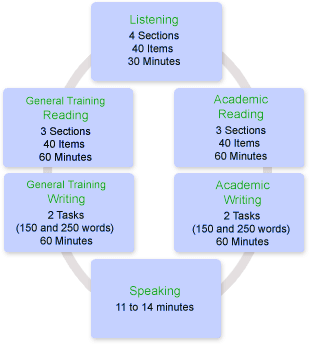
There are four sub-tests, or modules, to the IELTS test: Reading, Writing, Listening and Speaking. Students must sit all four sub-tests. While all students take the same Listening and Speaking tests, they sit different Reading and Writing tests, depending on whether they have selected the Academic IELTS test or the General Training IELTS test.

On the day of the test, the four subsections will be taken in the following order:
IELTS Test Structure


The Speaking test may even take place a day or two later at some centres.

IELTS listening test lasts for about 30 minutes. It consists of four sections, played on cassette tape, in order of increasing difficulty. Each section might be a dialogue or a monologue. The test is played once only, and the questions for each section must be answered while listening, although time is given for students to check their answers.

IELTS Reading test lasts for 60 minutes. Students are given an Academic Reading test, or a General Training Reading test. Both tests consist of three sections, and in both tests the sections are in order of increasing difficulty.

IELTS Writing test also lasts for 60 minutes. Again, students take either an Academic test, or a General Training test. Students must perform two writing tasks, which require different styles of writing. There is no choice of question topics.

IELTS Speaking test consists of a one-to-one interview with a specially trained examiner. The examiner will lead the candidate through the three parts of the test:
An introduction and interview, an individual long turn where the candidate speaks for one or two minutes on a particular topic, and a two-way discussion thematically linked to the individual long turn. This interview will last for approximately 11-14 minutes.


SOURCE:

TOEIC (The Test of English for International Communication)


A. Definition TOEIC

     The Test of English for International Communication (TOEIC) is "an English language test designed specifically to measure the everyday English skills of people working in an international environment." There are different forms of the exam: The TOEIC Listening & Reading Test consists of two equally graded tests of comprehension assessment activities totaling a possible 990 score; the newer TOEIC Speaking & Writing Test comprises tests of pronunciation, vocabulary, grammar, fluency, overall coherence, and structure (organization of sentences) totaling a possible 400 score.


B. TOEIC Listening & Reading Test

The TOEIC Listening & Reading Test is a two-hour multiple-choice test consisting of 200 questions evenly divided into listening comprehension and reading comprehension. Each candidate receives independent scores for listening and reading comprehension on a scale from 5 to 495 points. The total score adds up to a scale from 10 to 990 points. The TOEIC certificate exists in five colors, corresponding to achieved results:
  • orange (10–215) 
  • brown (220–465) 
  • green (470–725) 
  • blue (730–850) 
  • gold (855–990)


TOEIC Speaking & Writing Test 

The TOEIC Speaking & Writing Test was introduced in 2006. Test takers receive separate scores for each of the two tests, or can take the Speaking test without taking the Writing test. The Speaking test assesses pronunciation, vocabulary, grammar, and fluency, while the Writing test examines vocabulary, grammar, and overall coherence and organization. The tests are designed to reflect actual English usage in the workplace, though they do not require any knowledge of specialized business terms. The TOEIC Speaking Test takes approximately 20 minutes to complete; the TOEIC writing test lasts approximately 60 minutes. Each test has a score range between 0-200, with test takers grouped into eight proficiency levels.

Institutional TOEIC Test 

In addition to the official TOEIC tests, there are also versions that individual businesses and educational institutions can purchase for internal use. These "Institutional" TOEIC tests can be administered at the organization's own choice of location and time to their employees or students.

Benefits of TOEIC

1. Benchmarking Tool 
  • Verifies current level of English proficiency 
  • Identifies strengths and weakness and supports to set learning goals 
  • Monitors progress in English 

2. Serves Multiple Purposes 
  • Provides English language credentials global employers needs and supports migration 
  • Proves the English Skills required to succeed in workplace 

3. Reliable, Fair and Valid 
  • Measures everyday English Skills needed in the global workplace. 
  • Uses real world examples of spoken and written English collected from workplace around the world. 
  • Measure the intended attributes only 

4. Convenience and Flexibility 
  • Test can be administered at a business location at choice and online. 
  • Separation of listening & Reading from Speaking and Writing offers more flexibility 

5. Highly Accurate 
  • Offers quantifiable standard of performance with consistent and accurate scoring. 
  • Grounded with principle research in preparing and testing. 
  • Answers are Distributed among multiple raters to avoid discrimination and improve Quality. 


C. History of TOEIC

The Educational Testing Service (ETS) developed the TOEIC test to measure achievement in using English in a business setting. The Asahi Shimbun national daily's evening edition interviewed Yasuo Kitaoka who was the central figure of the Japanese team that conceived the basic idea of the TOEIC test.

According to an Aug. 11, 2009 Japan Times article, "In the 1970s, Kitaoka began negotiating with ETS to create a new test of English communication for use in Japan. ETS responded that it required a nonprofit organization to work with as their partner. Kitaoka tried to enlist the help of the Ministry of Education, but their bureaucrats did not see the need for a new test to compete with the STEP Eiken, an English test already backed by the ministry. To overcome this opposition, Kitaoka received help from his friend, Yaeji Watanabe. Watanabe's influence as a retired high-ranking bureaucrat from the Ministry of International Trade and Industry (renamed the Ministry of Economy, Trade, and Industry, or METI) proved crucial to TOEIC's establishment.

Watanabe had remained in contact with his old ministry while working on the board of directors for the World Economic Information Services (WEIS) and as chairman of the Japan-China Economic Association, both public-interest corporations operating under MITI. Watanabe declined an interview request, but his memoirs describe how he overcame Ministry of Education opposition to the TOEIC by taking cover "behind the ministry of trade shield." Watanabe convinced his old ministry it should play the lead role in establishing a new English test, and formed a TOEIC Steering Committee under the WEIS umbrella. Members of the committee included other retired MITI bureaucrats and influential business leaders.

Government support secured, ETS began developing the test in 1977. In 1979, English learners in Japan filled in the first of many TOEIC multiple-choice answer forms."

ETS's major competitors are Cambridge University, which administers the IELTS, FCE, CAE, and CPE and Trinity College London, which administers GESE and ISE exams.


D. New TOEIC Tests


A new version of the TOEIC Listening & Reading test was released in 2006. The changes can be summarized as follows:
  • Overall, passages are longer.
  • Part 1 has fewer questions involving photograph descriptions.
  • The Listening Section hires speakers of English from Britain, Australia, New Zealand and North America, and uses an equal distribution of the dialects. However all the voice actors for the speaking test have lived in the United States for an extended period.[citation needed]
  • Part 6 no longer contains an error-spotting task, criticized as unrealistic in a corporate environment, instead adopting the use of a task wherein the test taker fills in blanks in incomplete sentences.
  • Part 7 contains not only single-passage questions but also double-passage questions wherein the test taker reads and compares the two related passages, such as an e-mail correspondence.
According to a survey conducted in 2006 by the Institute for International Business Communication ( Zaidanhōjin Kokusai Bijinesu Komyunikēshon Kyōkai), 56.8% of the respondents who took both the older and the revised versions of the TOEIC test in Japan find the latter version more difficult. The lower the score the test taker achieves, the more marked this tendency becomes. As many as 85.6% of those who earned scores ranging from 10 to 395 points find the revised TOEIC test more difficult, while 69.9% of those who earned 400 to 495 points think this way, as do 59.3% of those who earned 500 to 595 points. Among those who achieved 600 to 695 points 58.9% agree with these findings. 700 to 795 points 48.6%, 800 to 895 points 47.9%, and 900 to 990 points 39.8%. 2006 also saw the addition of TOEIC Speaking & Writing tests. In 2007 there were additional changes to the TOEIC Reading & Listening test that decreased emphasis on knowledge of grammatical rules.


SOURCE:

Sabtu, 11 Mei 2013

APPLICATION LETTER and CURRICULUM VITAE (CV)

A. Application Letter

Application Letter is merely another name for a cover letter, the official business letter often included with a job application and/or resume and sent to a prospective employer.


Example of Application Letter:

Personnel Manager
PT.Bank Mandiri, Persero
Jl. Gatot Subroto
Kav 37-38
Jakarta Selatan


Dear, Mr.Dendy

  In response to your advertisement on job vacancy of The Jakarta Post for an accountant in your company. I am interested in your company to work as accountant. I am twenty one years old and i have worked as secretary for one year. And, I was graduated from Accounting Department of The Economics in Gunadarma University. I got a Certificate from Ikatan Akuntansi Indonesia (IAI) and my name has been registered in IAI office. Now I feel I have the necessary qualifications to fill the vacancy you offer.

  For your futher information, I enclosed my curriculum vitae (CV) which will give details of my qualifications. I hope you will consider my qualifications and grant me an opportunity to have interview.


Sincerely


Kammilah


B. Curriculum Vitae (CV)


CURRICULUM VITAE

1. PERSONAL DETAILS

Name                         : Kammilah
Place & Date of Birth  : Jakarta, December 07,1991
Sex                             : Female
Religion                       : Moslem
Marital Status              : Single
Nationality                   : Indonesian
Address                       : Jl. Batu Ampar Jakarta Timur 13520
Contact Number          : 081212 17xxxx

2. EDUCATION DETAILS

2010-2014 : Accounting of Departement Economics, Gunadarma of University Depok
2007-2010:  State Senior High School 51 Jakarta
2004-2007:  State Junior High School 126 Jakarta

EDUCATION NON FORMAL

2013 : English Course at  LIA (Certified)

3. WORK EXPERIENCES

2014-2015 PT. CIPUTRA GROUP as a Secretary
2015-2017 PT. Bank BCA as a Accountant

4. PROGRAM SKILLS

- Auditing
-MYOB
- ZAHIR
- Analysis

5. LANGUANGES
-Bahasa Indonesia
- English
-Germany


Minggu, 07 April 2013

Business Letter : Inquiry Letter and Complaint Letter

A. Inquiry Letter
     
  Inquiry letter is a kind of letter of demand or request   information about a product, service, job postings or other business information.

   In general, the general function of this letter is to respond to an advertisement of information sources such as newspapers, magazines or electronic media about a product / service as we are interested in the informasih obtained.

   Usually Suart is an initial step in building a business or cooperation of two parties: the provider of products / services and buyers of products / services.

   In this letter, there are some things that are discussed by the providers of services / products is the question of the buyer in order to help buyers themselves to find out information about products / services. Those things include:

  • Name and type of product
  • Product specifications, namely the type, size, quality, capacity and others;
  • Unit price.
  • Discounts
  • The method of payment from the buyer to the seller;
  • Way of delivery of the product from the seller to the buyer, and
  • Ease that may be obtained by the buyer, such as warranty and others.
   Inquiry Letter Example:


B. Complaint Letter

  Complaint letter is a sort letter which we use to help you achieve your goals from your complaint. The complaint letter should be addressed to the customer service/consumer affairs department or the head office if there is no customer service department.


 Complaint Letter Example:


1 Mawar StreetLosari, Brebes 52255

September 15, 2011

Customer Service
Batik Trusmi
15 Kibuyut Trusmi Street
Kel. Kesenden, Kec. Kejaksan
Cirebon 45121


Dear Sir or Madam,

I have ordered 12 packs consist of 12 clothes of new modeled Trusmi Batik on your Boutique which I ordered by phone on September 11. I received the order on September 14. When I received those packs of Batik, there was one packs missing. I only got 11 packs of 12 packs that I ordered. To know whether there was one pack missing, you can check the amount of Batik whcih left your Butique stock.

To resolve that problem, I would like you to send me one pack of modeled Trusmi Batik like I ordered before. Or if the pack of modeled Tursmi batik which I ordered had been ordered by somebody else, I hope you give me back the money for the amount charge of the Tursmi Batik pack.


I have been your costumer for long time, and you know it as well. This the first time I get the problem like this relate to your service. If you need to contact me, you can call me at 08743258234.


Sincerely,
 

Sartono


Source:

Rabu, 03 April 2013

Revenue


In business, revenue or turnover is income that a company receives from its normal business activities, usually from the sale of goods and services to customers. In many countries, such as the United Kingdom, revenue is referred to as turnover. Some companies receive revenue from interest, royalties, or other fees. Revenue may refer to business income in general, or it may refer to the amount, in a monetary unit, received during a period of time, as in "Last year, Company X had revenue of $42 million." Profits or net income generally imply total revenue minus totalexpenses in a given period. In accounting, revenue is often referred to as the "top line" due to its position on the income statement at the very top. This is to be contrasted with the "bottom line" which denotes net income.

For non-profit organizations, annual revenue may be referred to as gross receipts. This revenue includes donations from individuals and corporations, support from government agencies, income from activities related to the organization's mission, and income from fundraising activities, membership dues, and financial investments such as stock shares in companies.

In general usage, revenue is income received by an organization in the form of cash or cash equivalents. Sales revenue or revenues is income received from selling goods or services over a period of time. Tax revenue is income that a government receives from taxpayers.

In more formal usage, revenue is a calculation or estimation of periodic income based on a particular standard accounting practice or the rules established by a government or government agency. Two common accounting methods, cash basis accounting and accrual basis accounting, do not use the same process for measuring revenue. Corporations that offer shares for sale to the public are usually required by law to report revenue based on generally accepted accounting principles or International Financial Reporting Standards.

In a double-entry bookkeeping system, revenue accounts are general ledger accounts that are summarized periodically under the heading Revenue or Revenues on an income statement. Revenue account names describe the type of revenue, such as "Repair service revenue", "Rent revenue earned" or "Sales".

A. Business Revenue

Money income from activities that are ordinary for a particular corporation, company, partnership, or sole-proprietorship. For some businesses, such as manufacturing and/or grocery, most revenue is from the sale of goods. Service businesses such as law firms and barber shops receive most of their revenue from rendering services. Lending businesses such as car rentals andbanks receive most of their revenue from fees and interest generated by lending assets to other organizations or individuals.

Revenues from a business's primary activities are reported as sales, sales revenue or net sales. This includes product returns and discounts for early payment of invoices. Most businesses also have revenue that is incidental to the business's primary activities, such as interest earned on deposits in a demand account. This is included in revenue but not included in net sales.Sales revenue does not include sales tax collected by the business.

Other revenue (a.k.a. non-operating revenue) is revenue from peripheral (non-core) operations. For example, a company that manufactures and sells automobiles would record the revenue from the sale of an automobile as "regular" revenue. If that same company also rented a portion of one of its buildings, it would record that revenue as “other revenue” and disclose it separately on its income statement to show that it is from something other than its core operations.

B.Financial statement analysis

Revenue is a crucial part of financial statement analysis. A company’s performance is measured to the extent to which its asset inflows (revenues) compare with its asset outflows (expenses).Net Income is the result of this equation, but revenue typically enjoys equal attention during a standard earnings call. If a company displays solid “top-line growth,” analysts could view the period’s performance as positive even if earnings growth, or “bottom-line growth” is stagnant. Conversely, high net income growth would be tainted if a company failed to produce significant revenue growth. Consistent revenue growth, if accompanied by net income growth, contributes to the value of an enterprise and therefore the stock price.

Revenue is used as an indication of earnings quality. There are several financial ratios attached to it, the most important being gross margin and profit margin. Also, companies use revenue to determine bad debt expense using the income statement method.

Price / Sales is sometimes used as a substitute for a Price to earnings ratio when earnings are negative and the P/E is meaningless. Though a company may have negative earnings, it almost always has positive revenue.

Gross Margin is a calculation of revenue less cost of goods sold, and is used to determine how well sales cover direct variable costs relating to the production of goods.

Net income/sales, or profit margin, is calculated by investors to determine how efficiently a company turns revenues into profits....


C. Government Revenue

Government revenue includes all amounts of money (i.e. taxes and/or fees) received from sources outside the government entity. Large governments usually have an agency or departmentresponsible for collecting government revenue from companies and individuals.[6]

Government revenue may also include reserve bank currency which is printed. This is recorded as an advance to the retail bank together with a corresponding currency in circulation expense entry. The income derives from the Official Cash rate payable by the retail banks for instruments such as 90 day bills.There is a question as to whether using generic business based accounting standards can give a fair and accurate picture of government accounts in that with a monetary policy statement to the reserve bank directing a positive inflation rate. The expense provision for the return of currency to the reserve bank is largely symbolic in that to totally cancel the currency in circulation provision all currency would have to be returned to the reserve bank and cancelled.

D. Association Non-Dues Revenue
Association non-dues revenue is revenue generated through means besides association membership fees. This revenue can be found through means of sponsorships, donations or outsourcing the association's digital media outlets


Source: